The Ohio Department of Transportation (DOT) and the West Virginia Department of Transportation (WVDOT) have launched a collaborative engineering study to evaluate alternatives for a proposed four-lane US Route 33 crossing of the Ohio River. This major inter-state initiative is designed to dramatically improve long-term traffic safety, optimize commercial freight corridors, and strengthen regional economic connectivity between Meigs County, Ohio, and Ravenswood, West Virginia.
The Existing Infrastructure: William S. Ritchie, Jr. Bridge
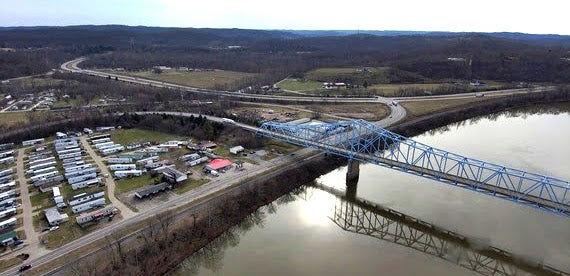
Currently, vehicular and commercial freight traffic crossing the Ohio River along the US 33 corridor relies on the William S. Ritchie, Jr. Bridge (historically known as the Ravenswood Bridge). Built as a two-lane facility, the structure is increasingly acting as a regional bottleneck.
While the highway alignment approaching the bridge on the Ohio side is direct and free-flowing, the West Virginia approach requires heavy transport vehicles and local motorists to navigate a complex series of low-speed turns, traffic light-controlled intersections, and restrictive quadrant ramps to successfully interface with Interstate 77.
| Infrastructure Feature | Current Status and Study Objectives |
|---|---|
| Official Structure Name | William S. Ritchie, Jr. Bridge (Ravenswood Bridge) |
| Current Design Capacity | Two-lane undivided highway cross-section |
| Primary Regional Corridor | Links US Route 33 (Ohio) directly to the Interstate 77 logistics grid (West Virginia) |
| Core Study Mandate | Evaluate alignments, environmental impacts, and design criteria for a new, high-capacity four-lane river crossing structure |
Core Project Drivers and Long-Term Demand Metrics
US Route 33 serves as a vital strategic transport corridor connecting major industrial hubs in Columbus, Ohio, to Charleston, West Virginia, and the broader southeastern United States logistics grid. Several critical planning variables are driving the necessity of this capacity expansion study:
- Accelerated Freight Growth: Ohio's long-range freight logistics roadmap (Transport Ohio) explicitly isolates this segment of the US 33 corridor as a high-growth zone. Driven by expanding manufacturing and supply chain networks, regional economic models project an additional influx of over 500+ heavy commercial trucks per day traversing this node by 2045.
- System-Wide Corridor Consistency: ODOT has finalized plans to widen the final remaining 25.6-mile two-lane bottleneck of US 33 through Athens and Meigs counties into a continuous four-lane divided expressway. This extensive widening project delivers a modern four-lane highway directly to the foot of the Ohio River crossing, making an upgraded bridge critical to avoid a severe merge bottleneck.
- Interstate Regional Efficiency: Transitioning the river crossing to a full four-lane configuration seamlessly aligns with incoming Ohio infrastructure updates. The expansion will establish a safer, continuous highway speed profile for long-distance commercial freight haulers and local regular commuters alike.
Public Informational Meeting Record
Community engagement remains an essential cornerstone of the bi-state project development process. Local residents, commercial business owners, and daily commuters were invited to attend a public open-house meeting hosted by both state departments to review preliminary engineering alternatives, study corridors, and environmental constraints:
| Event Detail | Meeting Information Archive |
|---|---|
| Session Date | Thursday, April 10, 2025 |
| Timeframe | 4:30 p.m. – 6:30 p.m. |
| Venue Staging | Ravenswood City Hall |
| Physical Address | 1 Wall Street, Ravenswood, West Virginia 26164 |
Digital Project Access: For stakeholders unable to attend the public session, complete mapping, preliminary engineering alternatives, and submission portals for public comment remain continuously accessible via the official project page hosted on the Ohio Department of Transportation Website.
Accessibility Statement:
The West Virginia Department of Transportation will, upon request, provide reasonable accommodations including auxiliary aids and services necessary to afford an individual with a disability an equal opportunity to participate in our services, programs, and activities. Please contact us at (304) 558-3931. Persons with hearing or speech impairments can reach all state agencies by calling (800) 982-8772 (voice to TDD) or (800) 982-8771 (TDD to voice), toll free.