Cut-Slopes Design Guidelines
Cut Slope Design and Benching Requirements
The Geotechnical Engineer shall design the cut slopes in accordance with the West Virginia Department of Transportation, Division of Highways Design Directive 400 series. For large cut slopes, one or two benches may be eliminated based on the modeling discussed below. Nonetheless, the 400 series Design Directives shall not be considered simply as guidance, and shall be performed first before considering eliminating a bench. Based on the modeling criteria below, the maximum distance between benches may be increased to a maximum of 80 feet with an increase in the bench width(s) immediately below that portion of the slope. If the modeling is not performed as discussed below, then intermediate benching is required for cut slope heights greater than 50 feet.
For all slopes greater than 25 feet, a bench shall be required when a resistive rock layer (Type 1 and 2 sandstone and limestone) at least 5 feet thick is underlain by a soft rock (Type 3 and 4 shale, claystone, or coal) 3 feet or thicker. When frequent alternating hard and soft layers are encountered in the borings, then a slope flattened to 3/4:1 (horizontal to vertical) may be substituted for this bench.
The design requirements with regard to maximum backslope ratio and minimum bench widths in the Design Directives shall be followed; however, when the dip of the rock bedding or jointing is greater than 20° and dips downward toward the traveled way, and the strike angle is less than 45° to the alignment, then kinematic rock slope analysis shall be used to flatten the backslope ratios and widen the benches to provide a factor of safety of 1.5 or greater.
When the overburden at the top of the cut is over 10 feet thick, a minimum 10-foot wide bench shall be constructed at the soil-rock contact. The backslope within the soil portion of the cut is preferred to be 2H:1V; however, when the soil thickness is over 10 feet a minimum factor of safety of 1.3 shall be demonstrated for the steepened soil slope.
Criteria for extending backslope height or eliminating a bench follows: the combination of slope ratio, height between benches, bench width, and catchment area shall result in 95% of rocks retained before entering onto the pavement as determined by the Colorado Rockfall Simulation Program (CRSP). In the absence of the rock fall data nearby, a 2.5-foot diameter spherical shape shall be modeled with a minimum of 500 rocks simulated. A total of five (5) simulations shall be performed for the proposed slope configuration and the one with the most rocks passing onto the pavement shall be used in determining the percent passing onto the pavement. The input parameters shall fall within the ranges presented as follows:
Rockfall Simulation (CRSP)
To extend backslope height or eliminate a bench, the Colorado Rockfall Simulation Program (CRSP) must determine that 95% of rocks are retained before entering the pavement. In the absence of nearby data, engineers must simulate a 2.5-foot diameter spherical shape with 500 rocks across five (5) simulations.
| Parameter | Hard Bedrock (Type 1 & 2) | Soft Bedrock (Type 3) |
|---|---|---|
| CRSP-2D Normal Coefficient (Rn) | 0.29 – 0.31 | 0.25 – 0.27 |
| CRSP-2D Tangential Coefficient (Rt) | 0.91 – 0.93 | 0.90 – 0.93 |
| CRSP-2D & 3D Surface Roughness (S) | 0.8 | 0.8 |
| CRSP-3D Hardness Coefficient | 0.80 – 0.82 | 0.52 – 0.54 |
Very Soft Rock (Type 4): For slopes above 50 feet in Type 4 rock, a global stability analysis considering planar and curvilinear failure surfaces must result in a Factor of Safety of 1.5 or greater.
Rockfall Catchment Area Ditch (RCAD)
In accordance with Design Directive 403, an RCAD shall be designed instead of a standard cut bench 5 feet above ditch grade for slopes 1H:1V or steeper.
- Design Parameters: Minimum 4H:1V Backslope B and a maximum height of 80 feet for Backslope A.
- Width Requirements:
- If Backslope A is 25 feet or less: Minimum 15-foot wide ditch.
- If Backslope A is greater than 25 feet: Minimum 25-foot bench.
Flatter Slopes: If a 3/4H:1V or flatter slope is planned above the RCAD, CRSP analysis must demonstrate that rocks do not outrun the ditch.
Image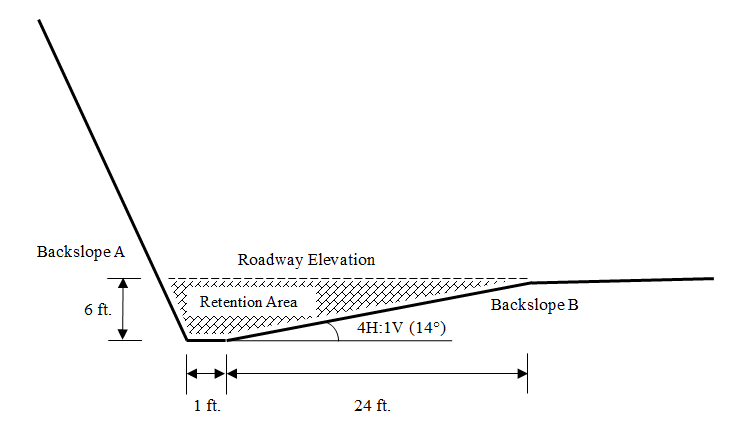
Accessibility Statement:
The West Virginia Department of Transportation will, upon request, provide reasonable accommodations including auxiliary aids and services necessary to afford an individual with a disability an equal opportunity to participate in our services, programs and activities. Please contact us at (304) 558-3931. Persons with hearing or speech impairments can reach all state agencies by calling (800) 982-8772 (voice to TDD) or (800) 982-8771 (TDD to voice), toll free.