End-of-Driving Drivability Analysis
The WVDOH requires all driven piles to bear into or on bedrock. Due to the relatively shallow and hard bedrock usually encountered in West Virginia, the driving stress typically controls pile size. Driving to refusal on bedrock is considered hard driving and requires the use of hardened steel pile points.
Wave Equation Analysis (GRLWEAP)
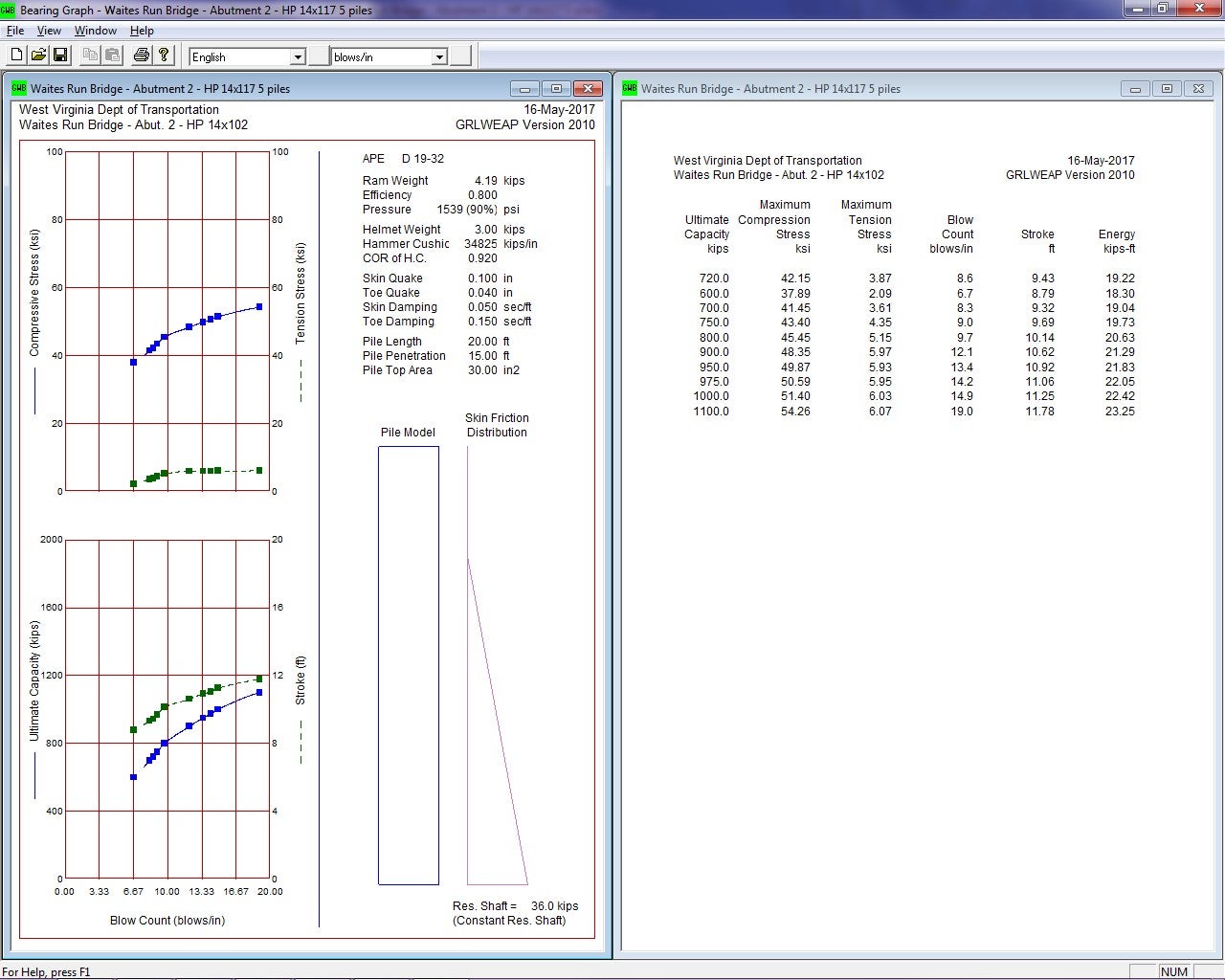
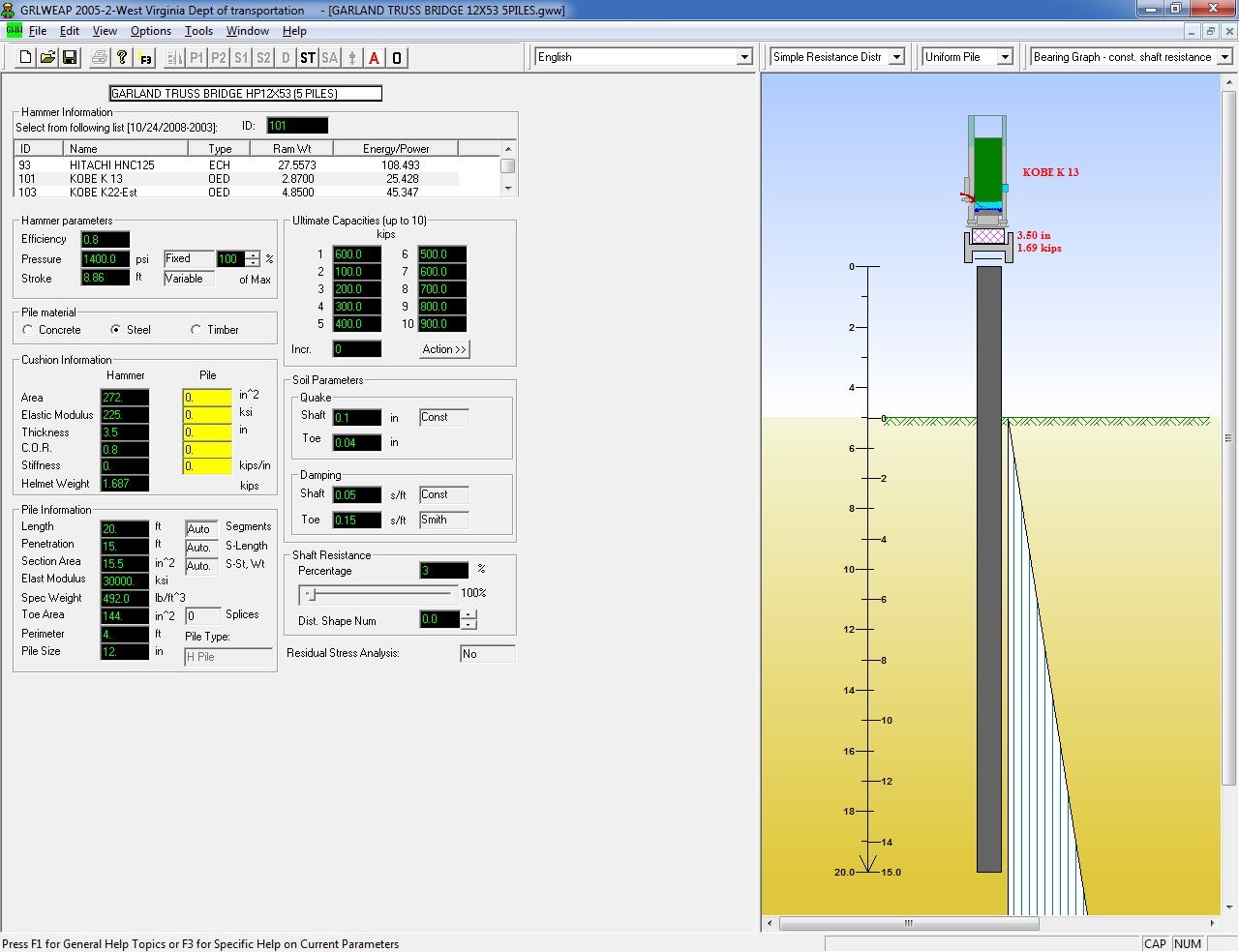
Because West Virginia piles are typically short, an end-of-driving analysis is required using wave equation software such as GRLWEAP. This analysis ensures the Contractor's driving system and cushion are matched to the pile size without exceeding specific stress limits.
- Stress Limit: Driving stress must not exceed 45 ksi.
- Modeling: Constant shaft resistance is typically modeled for short piles.
- Drivability Analysis: When pile depths exceed 40 feet, a full drivability analysis using proportional side resistance is recommended to size a hammer for reasonable driving times.
- Settings: Select "Bearing Graph - const. shaft resistance" in GRLWEAP. The target capacity should be entered in the first capacity box to set the constant shaft resistance.
- Toe Quake: Use values ranging from 0.04 for hard rock to 0.10 for very soft rock.
Refusal and Restrike Criteria
To protect driving equipment and ensure structural integrity, the following refusal limits apply:
- Hard Rock: It is desirable to limit driving to approximately 10 Blows Per Inch (BPI) to avoid hammer damage.
- Soft Rock: Refusal of 20 BPI is required.
- Restrike: In softer rocks prone to relaxation (claystone, mudstone, soft shale), a restrike may be required after a minimum of 3 days. Alternatively, boreholes can be advanced to harder rock.
Resistance Factors and Capacity
Design and analysis must adhere to LRFD standards:
- Geotechnical Resistance Factor: 0.50 is used for wave equation analysis without field testing.
- Target Capacity: Analysis must use a target (ultimate) capacity of 2 times the maximum factored axial pile load.
- Structural Limit: Piles should be sized to a maximum of 90% of the factored structural capacity. This accounts for the 45 ksi driving stress limit (90% of 50 ksi yield strength).
Predrilling and Integral Abutments
Predrilling is used to manage pile length and resistance in specific abutment types:
- Integral Abutments: Boreholes are predrilled a minimum of 15 feet below the bottom of the pile cap.
- 12-inch diameter through soil.
- 24-inch diameter through rock or boulders.
- Semi-Integral Abutments: Minimum pile length of 10 feet to provide resistance to pile bounce at refusal.
- Backfill: All predrilled holes must be backfilled with clean, dry sand prior to pile placement and driving.
Piling Design Notes for Contractors
| Hammer | Energy Rating (ft-lbs) | Fuel Setting | BPI @ Target Capacity |
|---|---|---|---|
| PILECO D19-42 | 42,506 | Max-1 (Highest) | 13 |
| DELMAG D 19-42 | 43,240 | Max-1 (Highest) | 15 |
| APE D19-32 | 47,126 | Max-1 (Highest) | 9 |
| ICE I-19v2 | 46,137 | Max-2 (2nd Highest) | 16 |
Hammer Limitations: Hammers larger than 47,126 ft-lbs are not allowed without prior approval. If a Contractor uses a hammer not listed, they must submit a new GRLWEAP analysis at least 14 days prior to installation.
Accessibility Statement: The West Virginia Department of Transportation will, upon request, provide reasonable accommodations including auxiliary aids and services necessary to afford an individual with a disability an equal opportunity to participate in our services, programs and activities. Please contact us at (304) 558-3931. Persons with hearing or speech impairments can reach all state agencies by calling (800) 982-8772 (voice to TDD) or (800) 982-8771 (TDD to voice), toll free.